| |
"Color is the keyboard, the eyes are the hammers, the soul is the piano with many strings. The artist is the hand that plays, touching one key or another to cause vibrations in the soul." — Wassily Kandinsky
Kandinsky did not only think this, he lived on it. He called his paintings Compositions and Improvisations, naming them for the thing he listened to, because music was where he went when he needed to know what a canvas was for. The theory came later. First there was the sound, and what it did to him.
It is worth sitting with. We quote the line as if the artist is the one at the keyboard, but before you play anyone's soul, someone plays yours. Music gets there first.
Every maker knows the flat afternoon, when the eye goes dull and the hand keeps working and nothing carries. You are doing everything right and the work has no pulse. Advice does not help. Looking at other art does not help either, because looking calls up the part of you that judges, and judgment is not what has gone missing.
So you put music on. Not to study it, and not to take a subject from it, but to let it do the one thing it does, which is to move something in you that has no name and needs none.
It gives you nothing to copy, and that is the point. A song is not an image. It offers no line, no color, no composition to lift. What it hands back is the state you make from. The tempo comes back into your hand, the room fills with a sense of movement, and the work remembers it is going somewhere.
This is why music and not the manual. A manual asks you to think, while music asks nothing. It works underneath the argument, in the place the marks actually come from. You are played first. Then you are able to play.
The finished work will not sound like the record that was on, and no one will hear it there. But it will carry the pulse. You will not be able to point to where the music entered. You will only know the piece has a heartbeat now, and that an hour ago it did not.
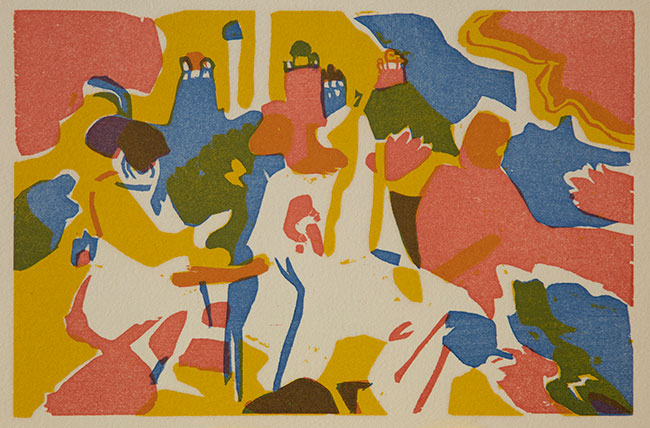
from our collection: Wassily Kandinsky (1866–1944), Orientalisches, 1913
Original woodcut, Roethel 106; this impression printed 1975 | 1236.20.12
|
|