 |
"Where love stories develop between art & viewer" |
||||
home | about | collection | giving | exhibit catalogs | exhibits | membership | amazon | inspired |
|||||
 |
|||||
A View from the Studio | Robin Jack Sarner |
|||||
“It’s like shedding my body at the door and becoming a conduit for a spiritual download.” |
|||||
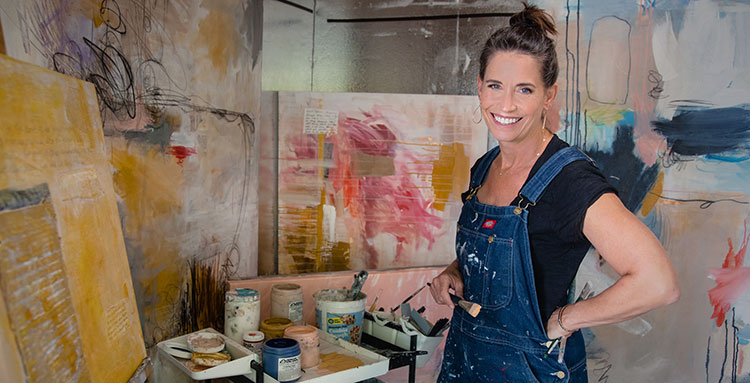
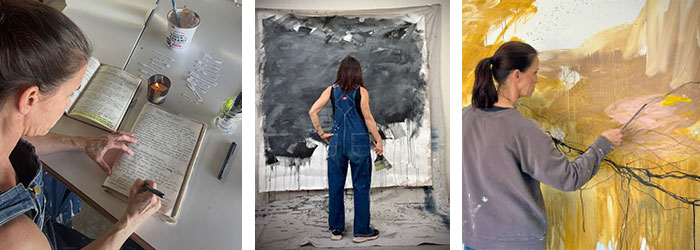
This is how Robin Jack Sarner describes entering her studio in Rancho Palos Verdes, California: a transformation from observer to creator, from the alert sensitivity of the outside world to the freedom of intuitive play within. For years, Sarner worked in a backyard studio no bigger than 8×12 feet. A year ago, she expanded into her entire garage, a shift that profoundly changed her practice. “Space affects my state of mind,” she explains. “I thrive in a large studio with room to move, natural light, and a connection to nature. Small spaces feel tight and congested.” While she acknowledges that art can be made anywhere, studio vibes matter to her. “For me, space is paramount.” On a new canvas, she might start with charcoal or dive straight into paint, depending on how she feels. “Usually, painting begins when I’m confident about the color and the force with which I approach the surface.” She’s recently begun working across multiple surfaces at once: canvas, wood cradles, and paper. Paper often comes first for studies, then that energy moves to canvas. “The beginning of a painting is my favorite part. It feels hopeful and limitless,” she says. She stops when a solution emerges, or when the answer remains elusive enough that continuing risks exhaustion. “Sometimes I stop simply because the painting feels complete. That’s the second-best feeling.” Pieces then remain on the wall until they’re ready for varnish. For Sarner, creating art isn’t limited to studio hours. She starts generating ideas the moment she wakes up, often continuing until she can’t keep her eyes open. Her surroundings, conversations, books, even mundane errands all feed her creative process. “The outside world is as important as the inside world,” she reflects. “My ‘outside’ artist is alert, sensitive, and open to ideas. In the studio, my inner artist takes over with the same awareness but with freedom to play, experiment, and follow intuition.” The studio becomes a sacred space: safe yet highly critical. Flow happens when the inner critic stops and trust takes over. Sometimes she keeps the studio silent during conceptual phases, but once work begins, she often listens to podcasts on art history or audio art books. “It keeps my brain focused like medicine.” Inspiration, for Sarner, is everywhere if you’re paying attention. Experiencing art in person, whether in galleries, museums, or live performances, is her greatest source of creative fuel. When she’s blocked, she visits art in person or online. When stuck on a painting, she goes into nature. When overstimulated, she reads or journals. “Emotion drives my work most of all,” she says. “Connecting to past or present feelings keeps my work deeply human.” Physically, she imposes conditions on herself to hold and carry daily emotion in a way that demonstrates repair without resolution. Visually, this translates to containing chaos, leaving it unresolved, and not letting it spill over the canvas edges. |
|||||
 |
|||||
| website: www.robinjacksarner.com | |||||
| instagram: @robinjackart |  |
||||
| For more Stories & Inspiration-sign up for SasseNews | |||||
© 2026 Sasse Museum of Art | 501(c)(3) Non Profit Organization | EIN: 90-0981234 | info@sasseartmuseum.org |
|||||